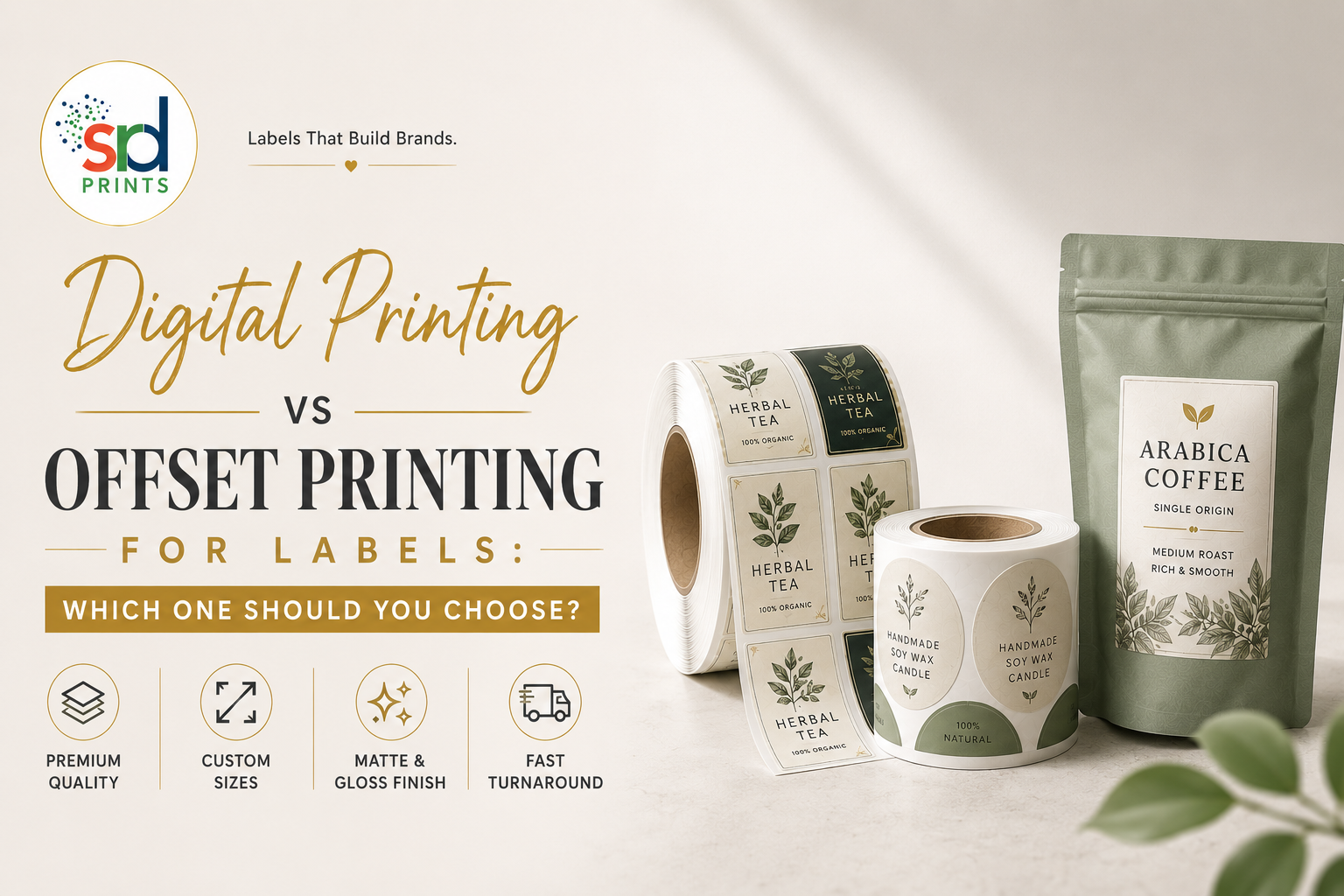
A lubricant brand walked into SRD Prints last month needing 2,000 bottle labels for a new SKU they were testing in just two markets. Same week, a pesticide company called in about 50,000 labels for their flagship product, already running nationwide. Both asked the same thing — Digital Printing vs Offset Printing which one actually makes sense for their stickers? We gave them two different answers, and that’s really what this comes down to. There’s no universal winner. It depends on your run size, your SKU, and how often your label design changes.
Digital Printing for Labels
Think of it as printing straight from file to sticker, no plates required. You send the artwork, the machine runs it, done. This is exactly why digital works so well for FMCG brands launching a new variant, or lubricant companies testing a small batch before a full production run. No plate cost to recover, so short runs stay affordable. It’s also the only real option when a pesticide brand needs different batch numbers, expiry dates, or regulatory text printed on each label — digital handles that without blinking.
Offset Printing for Labels
Offset’s the heavier-duty option, and for good reason. Metal plates, ink rollers, more setup time upfront — sometimes a day or more before the first sticker even comes off the machine. But once it’s rolling, the cost per label drops fast, and we mean really fast. This is why most large lubricant brands running 50,000+ bottle labels, or FMCG companies with a product that’s already scaled nationally, still print on offset. The plate cost stops mattering once volume gets big enough.
Where They Actually Differ For Sticker Printing
Here’s Digital Printing vs Offset Printing the way we’d break it down for a lubricant, FMCG, or pesticide client walking into our shop:
Setup cost — digital has next to none, offset needs plates made first, so there’s spend before you even start.
Run size — digital works well under 3,000-5,000 labels depending on the design; offset starts winning past that, and by 20,000+ it’s not close.
Turnaround — digital, easily, since there’s no plate-making delay holding things up.
Colour matching — this matters a lot for pesticide labels especially, since regulatory colours often need to be exact. Offset traditionally nails this better on big runs, though digital’s caught up a good deal.
Variable data — only digital can print different batch codes, expiry dates, or barcodes on each label without extra cost. Big one for pesticide and FMCG brands dealing with compliance labelling.
So Which One’s Actually Cheaper?
Comes down to quantity, plain and simple. That’s the real answer buried inside every Digital Printing vs Offset Printing question we get. Testing a new lubricant SKU with a 1,000-2,000 label run? Digital, no contest. Running an established FMCG product at 30,000+ labels a month? Offset will save real money over time.
Which Should You Pick?
Ask two things — how many labels, and does the design change often? New product, small batch, frequent tweaks? Digital. Established SKU, big volume, stable design? Offset. Most lubricant, FMCG, and pesticide clients fall pretty clearly into one camp once they know their monthly label count, which is usually the first thing we ask at SRD Prints.
Questions We Get From Label Clients
What’s the real difference between Digital Printing vs Offset Printing for stickers?
Digital prints direct from file, no plates, works out cheaper for small batches. Offset needs plates and setup time but gets much cheaper per label once you’re printing thousands.
We’re launching a new lubricant SKU — which should we use?
Digital, most likely. Small test runs don’t justify the plate cost of offset.
Our pesticide labels need batch numbers and expiry dates on each one — can offset do that?
Not economically. That’s where digital wins, since it can print variable data on every label without extra charges.
At what quantity does offset become worth it for label printing?
Honestly there’s no fixed number — it moves around based on the design and how many colours are involved. As a rough guide, once you’re well into five figures a month, offset usually starts pulling ahead.
Does colour accuracy matter more for one method?
Offset generally holds tighter colour consistency across a big batch, which matters for regulated products like pesticides where label colours often follow strict guidelines.
Does SRD Prints handle both label types?
Yes, both, in-house. Give us a call, mention what you’re labelling, your rough monthly count, and whether the artwork keeps changing — from there it’s usually easy for us to point you the right way.
Bottom Line
For lubricant, FMCG, and pesticide labels, Digital Printing vs Offset Printing isn’t really a competition — it’s a question of volume and how often your design changes. Small, frequent, or variable runs lean digital. Large, stable, high-volume runs lean offset. SRD Prints runs both, so whatever your next label order looks like, you’re getting the option that actually fits your product, not just whatever we happen to push. Get in touch and we’ll quote it properly.
Read also :- https://srdprints.com/digital-printing-in-delhi/