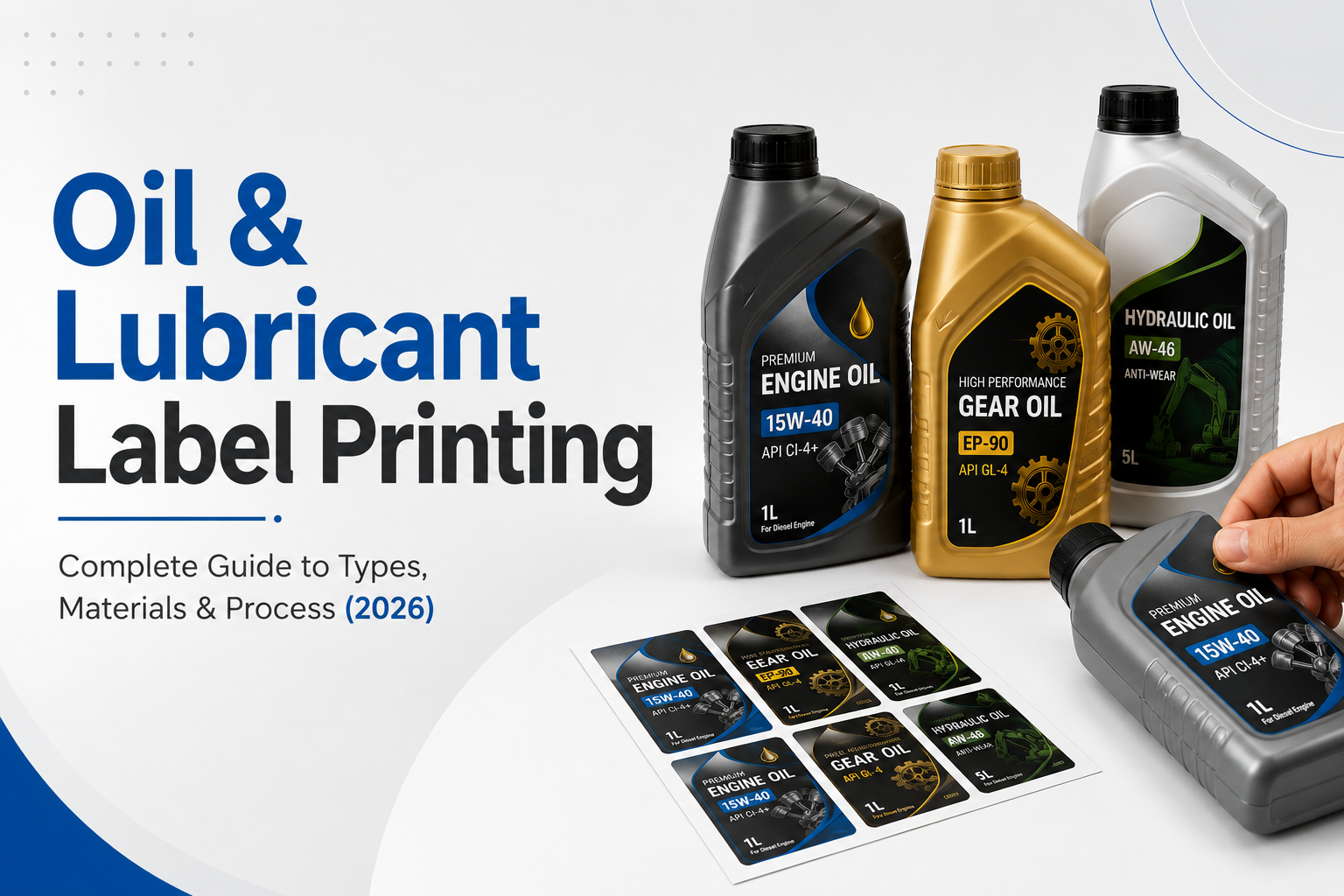
Pick up any can of engine oil that’s been sitting on a garage shelf for six months. Run your thumb across the sticker. Still crisp, still stuck down tight? Someone got the label right. Curling at the corner, or the viscosity grade faded into a smudge you can barely read anymore? Someone cut a corner, somewhere along the line. That’s really the whole story of oil & lubricant label printing, told in one small gesture — the label has to outlast the product it’s describing, not just look nice in a design file on somebody’s laptop.
And no, this isn’t only about cooking oil, even though that’s probably what comes to mind first. Motorcycle oil, gear oil, hydraulic oil, tractor oil, transmission fluid — the whole lubricant shelf lives under the same pressure. Oil seeps into places it shouldn’t. Cans sweat in humid weather. Engine bays run hot enough to test any adhesive. Warehouses stack drums for months before anything even reaches a workshop floor. Get the label wrong and it won’t fail on day one — it’ll show up three weeks in, right when a customer actually needs to read the grade off a can that’s starting to peel. That’s the pressure test every job in oil & lubricant label printing has to pass, whether anyone’s watching or not.
What Actually Falls Under Oil & Lubricant Label Printing
Oil & lubricant label printing covers the design and production of labels for anything oil-based. Cooking and essential oils sit on one end of that spectrum. The much bigger world of automotive and industrial lubricants sits on the other — engine oils, gear oils, hydraulic oils, transmission fluids, tractor oils, plus specialty products like steering oil or pumpset oil that nobody thinks about until they need one.
A regular paper label doesn’t survive this category, and it was never built to. Between the residue, the moisture, the heat — oil & lubricant label printing calls for materials and adhesives picked for toughness first, looks a distant second. Lubricant labels carry one more job on top of all that: a mechanic scanning a shelf needs to read the viscosity grade and performance spec in about two seconds flat. Legibility isn’t a nice-to-have here. It’s more or less the entire point of the label existing at all.
Why This Category Gets Treated Differently
Dry goods can get away with a basic sticker. Oils and lubricants really can’t, and there’s a handful of reasons why.
A label that smudges the moment oil touches it is a dead giveaway to any customer, and in a workshop, spills aren’t an occasional thing — they’re constant. Humidity is the second front here. Kitchens, warehouses, open-air garages — they all work against paper and ink in slow, quiet ways nobody notices until the label’s already gone soft underneath. Then there’s the sheer physical abuse a container goes through: shipped, stacked, stored, handled by greasy hands, sometimes for a year before anyone even cracks it open. And on top of all that, whatever’s printed has to stay readable the entire time it’s sitting on a shelf — an FSSAI number for edible oil, or a viscosity grade and API/JASO spec for a lubricant, where the wrong number ending up in the wrong engine is a genuinely expensive mistake for somebody.
Put all of that together and it stops being surprising that oil & lubricant label printing gets treated as its own specialty, rather than farmed out to whichever printer quotes the cheapest job that week.
The Product Range: What Actually Needs a Label
Here’s the full spread of products that typically fall under oil & lubricant label printing, along with the grade or spec that has to stay legible on each one. Wasn’t expecting this many rows myself the first time I laid it out — but every workshop shelf really does carry this much variety.
| Product Category | Common Grades / Types | Typical Pack Sizes |
| Engine Oil | 15W40 (CH4/CF4/CI-4/CI-4+), 20W40 (CF4/CF/SF/ED), 20W50 (CH4) | 500ml, 1L, 3.2L |
| Motorcycle Oil | 20W40, 20W50 | 500ml, 1L |
| 2-Stroke / 4-Stroke Oil | 2T Oil, 4T Oil | 500ml, 1L |
| Gear Oil | EP-90, EP-140, 80W90, 75W90, 85W140 | 1L, 5L, drum |
| Hydraulic Oil | AW-32, AW-46, AW-68 | 5L, 20L, drum |
| Transmission Oil | TQ-1 / ATF | 1L, 5L |
| Tractor Oil / UTTO | 20W-10W Universal Tractor Transmission Oil | 1L, 5L, drum |
| Steering Oil | — | 500ml, 1L |
| Pumpset Oil | — | 500ml, 1L |
Every row up there is really its own label design problem. Different viscosity callout, different color code, different pack-size die-cut, sometimes a completely different customer reading it. That’s a lot of ground for oil & lubricant label printing to cover under one roof, which is why brands running a wide product line need a printer actually built for this — not one just testing the waters with their first lubricant order. A brand jumping from cooking oil into motorcycle oil or hydraulic oil finds out fast that oil & lubricant label printing isn’t a copy-paste job between categories. What works fine on a kitchen bottle can fall apart within a month on a workshop shelf.
Materials That Actually Hold Up
Material choice is where oil & lubricant label printing quietly wins or loses the whole job before printing even starts. There’s no single “right” answer here, honestly — it depends on the container, the product, and, let’s be real, the budget too.
BOPP (Biaxially Oriented Polypropylene) is the default for most oil & lubricant label printing work, and it earns that spot fair and square: waterproof, and it shrugs off oil and grease contact without much fuss. Vinyl earns its place on irregular containers — think grease cartridges, curved drums — because it flexes instead of cracking under stress. Polyester handles heat better than almost anything else here, which matters when engine oil cans are baking in a hot storeroom, or tractor oil drums are sitting out in an open yard all summer long. Laminated paper still shows up too. Cheaper to start with, no argument there, but it wears out fast the second real oil gets involved.
Getting this one choice right, early, is probably the single biggest factor in whether a label survives its intended shelf life. Everything else downstream depends on it, more than people expect.
Printing Methods, and When Each One Makes Sense
There isn’t one universal method for oil & lubricant label printing either. The right press depends on volume, budget, and — honestly — how premium the container needs to look sitting on a shelf next to competitors.
Flexographic printing is the workhorse for high-volume runs — fast, and the cost per unit drops hard once you hit scale. That’s why so much mass-market oil & lubricant label printing runs through flexo presses; nobody’s printing a hundred thousand engine oil labels any other way.
Digital printing suits smaller batches, or designs that are still being tested out. No plates, no setup cost, easy to tweak on short notice — genuinely useful when a brand’s rolling out a new grade, say a fresh hydraulic oil variant, and isn’t locked into a final design yet.
Offset printing is where premium brands land when they want sharp detail and precise color. Costs more upfront, sure, but the finish shows on the shelf, and it keeps a consistent look running across an entire product family.
Screen printing turns up on glass bottles and specialty containers now and then, usually when the goal is a premium finish over raw speed.
How the Process Actually Runs, Step by Step
The full workflow behind oil & lubricant label printing follows a fairly fixed sequence, and skipping a step anywhere in it tends to catch up with you eventually — maybe not that week, but eventually. Design comes first: matching the brand while satisfying whatever regulations apply, and making sure the viscosity grade and performance spec sit front and center where they actually belong. Material gets chosen next, based on the container and where it’s likely to sit in storage. Then actual printing happens, using whichever method fits the volume and the budget. A lamination or protective coating usually follows, adding resistance against oil and grease. Die-cutting shapes the label to the exact bottle, can, or drum it’s headed for. A quality check catches weak adhesive, print errors, or a grade number that’s gone blurry — before any of it ships out the door. Application is the last step, done by hand for smaller runs, or by machine once volumes climb.
Skip a step in oil & lubricant label printing and it almost never shows up right away. It shows up three weeks later, quietly, when a label that looked perfect off the press starts lifting at the edge.
Compliance: The Non-Negotiables
This is the part where oil & lubricant label printing stops being a design exercise and turns into a legal one. Edible oils have their own list to satisfy: an FSSAI license number, net quantity, manufacturing and expiry dates, nutritional information, and a batch number for traceability.
Lubricants carry a parallel set of requirements, just swapped out for their own category. Viscosity grade, API or JASO performance spec, net quantity, batch number, manufacturing and expiry dates — all of it needs to be present and genuinely easy to read, because a mechanic or fleet manager is trusting that label to help them grab the right product off a crowded, oily shelf.
Miss any of it and it’s not just a paperwork problem. It’s the kind of gap a customer actually notices, and once they notice one thing missing, they start wondering — fairly reasonably — what else got skipped along the way.
Frequently Asked Questions
What’s the best material for oil & lubricant label printing?
BOPP wins most of the time, across cooking oil and lubricants alike, mainly because of how well it handles water and oil. That said, the right call still depends on the container and the storage conditions — which, honestly, is the core decision behind pretty much any oil & lubricant label printing job.
What’s the cheapest way to get started for a small lubricant brand?
Digital printing, no real competition there. No expensive setup, and changing a design later — launching a new gear oil grade, say — doesn’t mean starting over from scratch.
Do lubricant labels legally need certification details?
For edible oil, yes: FSSAI number, net quantity, batch number, expiry date, all of it legible. For lubricants, the viscosity grade and performance spec need to be just as clear and just as accurate.
How long should a properly printed label actually last?
With BOPP or polyester plus a lamination layer, labels generally hold up through the full shelf life — a year or two without fading, even on cans and drums that take a fair amount of rough handling along the way.
Can I just use plain paper labels on oil containers?
You can. It’s just not a great idea unless it’s laminated first — plain paper tears or smears the moment oil, grease, or any real moisture gets near it.
The Short Version
At its core, oil & lubricant label printing comes down to one honest question: will the label survive contact with the product it’s describing? Get the material right, match it to a printing method that actually fits your volume, and keep the grade and pack size easy to read at a glance — do that, and the label holds up. Skip it, and the thing looks fine sitting in a box on day one. By week three it’s peeling at the corner, and somebody in the office is stuck explaining to a distributor why half a batch came back.
Doesn’t really matter what’s in the bottle — motorcycle oil, gear oil, hydraulic oil, transmission fluid, tractor oil, pumpset oil, whatever. You start in the same place every time: what’s the container, where will it sit in storage, what’s the budget, and which numbers on that label can’t afford to blur. Once those are answered, the rest — material, method, coating — pretty much falls into place on its own.
also read this :- https://srdprints.com/lubricant-sticker-printing-in-delhi/